Analysis of Inventory Systems
Preface
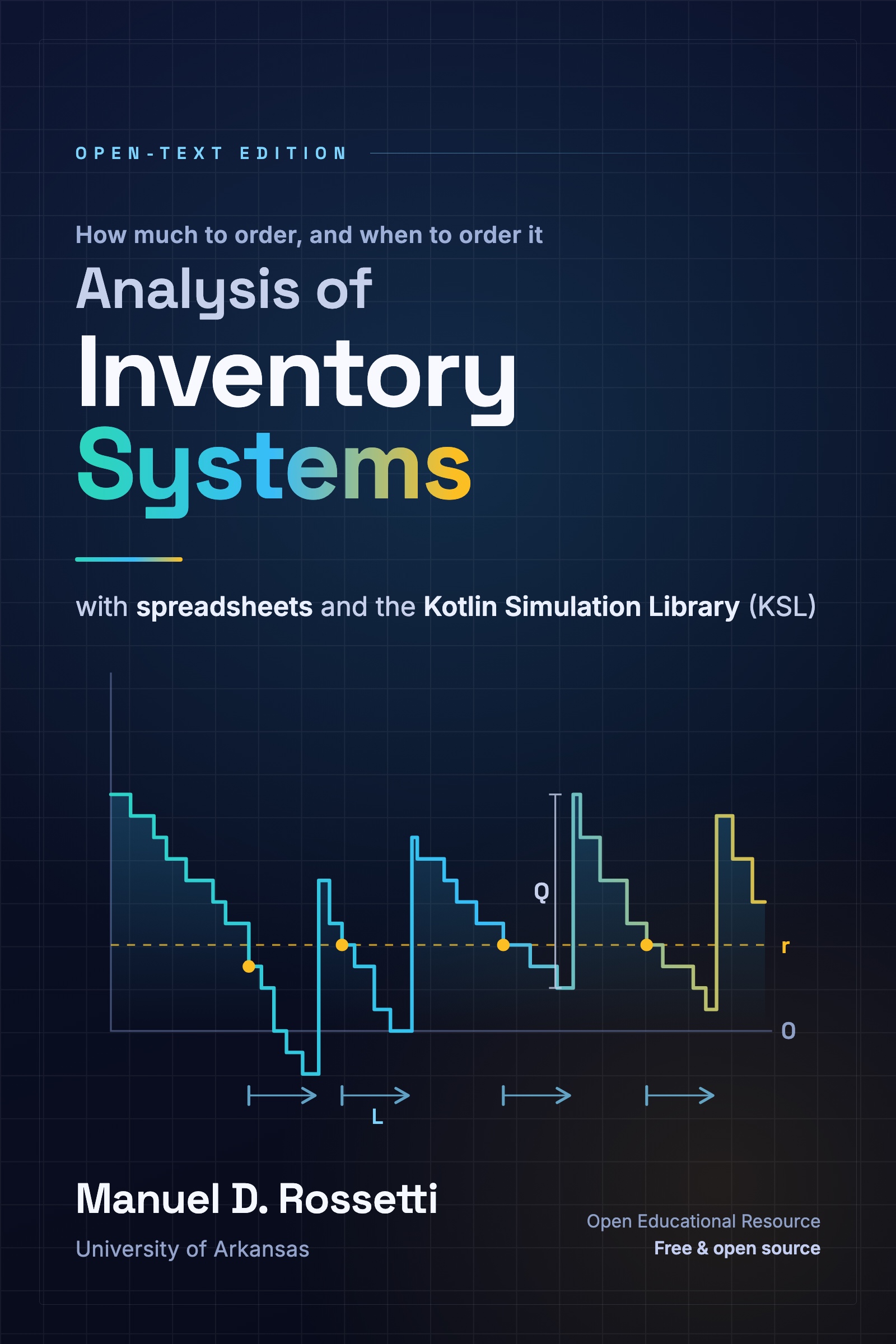
This book is intended as a textbook for an upper-level undergraduate or introductory graduate course on the modeling and analysis of inventory systems. It is written for engineering students, primarily industrial engineering, but is also suitable for students in operations management, supply chain management, and data science who have the necessary background in probability and statistics.
The material assumes that you have had a calculus sequence and a first course in probability and statistics. Familiarity with basic optimization concepts is helpful but not required; the optimization needed for the models developed here is introduced as it is used.
Approach
Inventory theory sits at the intersection of stochastic modeling and optimization. The organizing question throughout this book is simple to state and difficult to answer well:
How much should we order, and when should we order it?
Every model developed here is an answer to that question under a particular set of assumptions about demand, lead times, cost structure, and the review process. The emphasis is on understanding which assumptions produce which policy, and on what happens when the assumptions fail. Analytical models are developed first; simulation is then used to study systems that resist closed-form analysis and to check how far the analytical results survive their assumptions.
How this book is organized
The development moves from deterministic to stochastic, and from single-location to multi-echelon systems:
- Foundations: the structure of inventory systems, the costs and service measures used to evaluate them, and the management of items and records.
- Deterministic models: lot sizing when demand is known, for one item and for many, for constant demand and for time-varying requirements, and requirements planning across a product structure.
- Stochastic models: single-period decisions, continuous- and periodic-review policies for repeated ordering under uncertainty, and repairable items circulating between two echelons.
Each chapter closes with exercises. Some are analytical, some require computation in a worksheet or in Kotlin, and one asks you to check a closed form by Monte Carlo simulation.
Software
Two tools carry the computational work in this book, and each is used where it is the right instrument.
Spreadsheets handle the numerical models. Most of what this book asks you to compute, such as a lot sizing schedule, an MRP record, or a policy’s expected cost, is naturally tabular and time-phased, and a spreadsheet shows the whole calculation at once in a way that a printed formula cannot. Worked spreadsheets accompany the chapters, and several exercises ask you to extend one. You are expected to be comfortable building and auditing a spreadsheet model.
Kotlin and the Kotlin Simulation Library (KSL) handle the simulation work, where a system’s behavior has to be generated rather than solved for. Appendix E — Kotlin and KSL Setup covers installing the tools and running your first model. The KSL is developed and documented separately; see Simulation Modeling using the KSL for a full treatment of the library.
Some figures and tables in the text are generated programmatically so that they stay consistent with the numbers around them. That tooling is an authoring convenience and is not shown, taught, or required of you.
A note on notation
Inventory theory has an unfortunate amount of notational variation across the literature. This book fixes a single notation and uses it consistently; where a symbol differs from the common usage in a widely cited source, the difference is noted so that you can move between this text and the literature without confusion.
How this book was written
This book began as course notes. I have taught inventory theory to industrial engineering students for more than thirty years, most recently as Analysis of Inventory Systems at the University of Arkansas, and over that time the notes accumulated lecture slides, worked spreadsheets, homework sets, exams, and the results of a long series of funded research projects on inventory and supply chain problems. The raw material was plentiful. What it lacked was a single notation, a single running example, and a consistent standard of proof that a number printed on the page is the number the model actually produces.
The book is written in Quarto. Each chapter is a Markdown file with mathematics in LaTeX, and one source renders to both the website and the PDF. The whole book, including its code, workbooks and build scripts, lives in a version-controlled repository, so every change to a chapter is recorded alongside the computation that supports it.
Every number is computed, not typed. The Kotlin code that accompanies the book, built on the KSL, is a Gradle project with automated tests, and the tests assert the values the chapters print. The spreadsheets are generated by scripts and then recalculated and checked against the same Kotlin results, so a worksheet and the code must agree before either is published. In addition, a set of scripts checks the cross-references, the citations, the spelling, and the consistency of the prose with a written style guide on every build. Thus, when an example, a figure, or an exercise solution quotes a value, some piece of code produced it and some test will fail if it changes.
I wrote this book with the help of an AI assistant, Claude, developed by Anthropic. That is, I used it the way I would use a fast and patient research assistant. It turned decades of notes into draft sections under the style guide derived from my earlier book; it wrote and tested much of the companion code and the scripts that build the workbooks; it worked exercise solutions and pinned their numbers in code; and it read the papers the book cites, so that each citation could be checked against what its source actually says. For example, the exact two-echelon results of 10 Multi-Echelon Systems with Batch Ordering were reproduced from the published tables before any approximation was measured against them. The decisions were mine: what the book covers, in what order, with which models and which examples, and what a student should be able to do at the end of each chapter. I reviewed every section, and the assistant’s work was held to the same standard as my own, which is that a claim is accepted when a computation confirms it. Any errors that remain are my responsibility.
Acknowledgments
Much of what this book knows about inventory systems in practice was learned on sponsored projects, and I am grateful to the organizations that posed the problems and funded the work. The National Science Foundation supported this work directly and, through its Industry/University Cooperative Research Centers program, through the Center for Engineering Logistics and Distribution (CELDi), which I had the privilege of directing at the University of Arkansas. The Defense Logistics Agency sponsored more than a decade of projects on inventory record accuracy, sourcing, lead time variability, item classification, bulk petroleum supply chains, and multi-echelon inventory modeling. The Naval Supply Systems Command, the Air Force Research Laboratory, and the Air Force Office of Scientific Research supported work on readiness-based sparing, spare parts segmentation, stockage policy, and forecasting for military logistics, and the Pine Bluff Arsenal and the Red River Army Depot supported work on materials management and depot logistics. The Arkansas Science and Technology Authority funded early work on the simulation of supply chain networks. In industry, Walmart, Invistics, Covidien, and Medtronic brought problems in inventory accuracy, intermittent demand, service levels, continuous replenishment, and healthcare supply chains, and the Center for Innovation in Healthcare Logistics at the University of Arkansas supported work on the healthcare supply chain.
Many of the models in this book were first worked out, tested, or taken apart by my students. I thank the doctoral students whose dissertations on inventory and supply chain systems I chaired: Mohammad H. Al-Rifai, Vijith Varghese, Yasin Unlu, Mohammad Shbool, Anvar Abaydulla, Payam Parsa, and Alireza Sheikh-Zadeh; and those on whose dissertation committees I served: Ghazi Magableh, Mehmet Miman, and Yisha Xiang. I thank the students whose master’s theses on these problems I chaired: Yeu-San Tee, Ashish Achlerkar, Vijith Varghese, Vikram Desai, Seda Gumrukcu, Yanchao Liu, Server Apras, and Tanvir Sattar; those on whose thesis committees I served: James Oldham, Derek Malstrom, Yisha Xiang, Ronald Walker, and John Sophabamixay; the students whose master’s projects I directed: Ravi Kurgund, Hin-Tat Chan, Soncy Thomas, Kiran Chittoori, Josh McGee, and Amit Bhonsle; David Cox, whose honors thesis I chaired; and Julianna Bright, for research on \((r, Q)\) optimization and bulk petroleum supply chains. Their questions made the notes better long before the notes became a book.
License
The online version of this book is licensed under the Creative Commons Attribution-NonCommercial-NoDerivatives 4.0 International License. The Kotlin code that accompanies it, in the code project beside the book, is licensed under the GNU General Public License, version 3, the same license as the KSL itself. To cite this book:
Rossetti, M.D. (2026). Analysis of Inventory Systems, On-line and Open Text Edition. Retrieved from https://rossetti.github.io/RossettiInventoryBook/, licensed under the Creative Commons Attribution-NonCommercial-NoDerivatives 4.0 International License.